

From Buy-In to Ownership: The Accountability Shift
- Philip Edgell
- Jul 14, 2025
- 4 min read
TL;DR:
The most effective teams hold each other accountable, not just report upward.
Shift from leader-centric ownership to peer-driven commitment.
Use shared purpose, public commitments, and rituals to reinforce accountability culture.
Your role isn't to carry the team, it's to create the structure where ownership thrives.

"I feel like I am trying to sell them on the idea to get their buy-in."
Have you had this experience?
A critical company initiative, and you are in charge.
You have a high-performance team who are still responsible for their day job. You have no positional authority over the group, and you need them to be successful.
Inspiring accountability was the challenge of a recent coaching call.
I am assisting a company with a strategic project to redefine their ideal customer, marking the next milestone in a complex strategy engagement.
Our hero in the story has been struggling to get consistent buy-in from the project team. His approach has been to sell the merits of the project as a method of appealing to the team to engage.
My question to him was, "Whose responsibility is it to 'buy in' to the project? And who needs to be accountable for the output?"
Like most leaders, he felt like the responsibility and accountability were all on his shoulders.
When leaders feel like they're selling their teams on critical initiatives, it's a signal that ownership and accountability are misaligned.
This dynamic puts too much weight on the leader and not enough on the team.
The most effective teams don't require persuasion; they need clarity, context, and consequences.
Here's the problem: traditional accountability flows upward.
The leader is accountable for the team, but the team isn't always equally accountable to each other or the outcome.
The result? One person carries the weight while others are disengaged. Decision-making slows down due to the bottleneck at the top, the leader can't build capacity through their team, and the whole group underperforms.
What is the solution? Make accountability a team sport.
As Lencioni said, "Peer-to-peer accountability only works when there is clear agreement on what the team has committed to and the trust to call each other out."
3 Levels of Accountability (And Where Most Teams Get Stuck)
Leader-to-Team Accountability
This is where most teams live. The leader defines the goal, checks in, drives progress, and shoulders the responsibility for success or failure.
Team-to-Leader Accountability
Team members report status updates and progress to their leader. This creates some movement, but it still puts the leader at the center.
Peer-to-Peer Accountability
This is the unlock. When teams hold each other accountable, not just upward, it creates a shared sense of responsibility and urgency. A culture of ownership takes over.
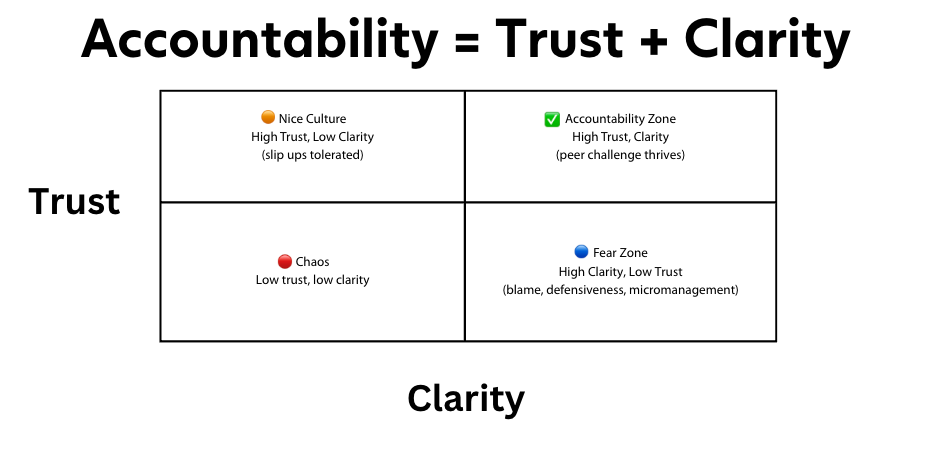
How to Build Peer Accountability With or Without Positional Power
✅ Start with Shared Purpose
Clarify the "why" behind the initiative. People don't buy into a task; they buy into a mission. Invite them to own the mission, not just comply with the instructions.
Ask: "What does success look like for all of us?"
Ensure each person sees their fingerprint on the outcome.
✅ Reframe Buy-In as Contribution
If you find yourself selling the project, flip the script: instead of asking for their buy-in, ask for their contribution to the outcome.
Ask: "Here's where we're headed, what part of this do you want to own?"
Ask: "What would make this meaningful for your team?"
The team turns from passengers into co-pilots.
✅ Make Commitments Public
Private commitments are easy to forget. Public commitments elevate follow-through. Use team meetings to share:
Ask: "What am I committing to this week?"
Affirm: "Here's why I'll deliver, and by when."
This creates gentle social pressure and removes the leader as the bottleneck for progress.
✅ Build Rituals That Reinforce Ownership
Establish team check-ins, retrospectives, or weekly stand-ups where accountability becomes a habit, not a surprise. Peer-to-peer recognition and peer feedback accelerate the shift.
Ask: "Who helped you this week?" or "Where did we miss as a team?"
Encourage the team to coach and challenge each other, not just look to you.
✅ Stop Catching All the Problems
When you solve every roadblock, you disempower the team. Instead, return ownership to the group.
Ask: "What do you think we should do?" or "Who needs to be involved to unblock this?"
Ask: "How will I know you are making progress towards a resolution?"
The goal is to create space for accountability to emerge, not to absorb it all yourself.
Leadership Insight
Accountability is a mirror of culture. If the team sees accountability as the leader's burden, they will behave accordingly. But when the leader sets the expectation that accountability is shared, teams rise to meet it.
Empowered teams don't wait to be asked. They take initiative, support each other, and hold the standard because it matters to them, not just to their manager.
As a leader, your job isn't to carry accountability; it's to create an environment where it thrives.
What about our Hero from above?
He engaged the key members of the team to affirm the importance of the project to the company, and then he asked them:
"What is the barrier to your full participation?"
Next time you're tempted to "sell the idea," pause and ask:
"What system or behaviour is making me the salesperson instead of the sponsor?"
Then, shift the structure to empower the team to own the outcome, together.


Comments