

You Are Not Solving Problems. You Are Treating Symptoms.
- Philip Edgell
- Apr 24
- 6 min read
TL;DR:
The Firefighter Trap: Smart, experienced leaders get stuck solving the same problems repeatedly because they respond to events rather than addressing the conditions that create them.
The Systems Question: Event thinkers ask, "What do I do about this?" Systems thinkers ask, "What conditions exist that made this outcome inevitable?"
The Three Levels of Curiosity: The depth of the question you ask determines the level of solution you are capable of finding.
The Architect Transition: Increasing the capacity of the system you lead requires moving from solving problems to redesigning the conditions that produce them.

I Am Not Here to Help
"What are you doing? I thought you were supposed to be helpful."
Not usually the words you want to hear from a paying client. But sometimes the most helpful thing a coach can do is refuse to help.
Here is what happened.
I was sitting with a senior executive who was running on fumes. Not the glamorous kind of busy, the desperate kind. The kind where exhaustion has moved from their calendar into their body. They sat across from me, shoulders slumped forward, voice tight, and launched into a list of problems that had become so familiar they could recite them without thinking.
Same problems. Different quarter. Every time.
My coaching strategy was to keep asking two questions.
"What else?" and "What caused that?" in order, over and over.
We went on like this for the better part of ninety minutes. No advice. No frameworks. No solutions. Just those two questions on repeat.
Finally, they stopped, looked at me with equal parts exhaustion and irritation, and said what you already know they said.
"What are you doing? I thought you were supposed to be helpful."
My instinct was to ask another question, but I thought better of it.
Instead, I said: "I have a hypothesis. The reason you are feeling the way you are is that you have been treating symptoms. My instincts tell me that we are not getting to the root of the problem. Aren’t you curious about the upstream conditions that are creating the symptoms? Because if we can identify and change those conditions, the symptoms disappear automatically."
They were quiet for a long moment. In this instance, there was no immediate light bulb. The concept needed to marinate.
Our next coaching session marked a change. It was not frustration with the problem, but curiosity about the conditions that caused it. It felt like we were on a new path.
The Pattern Behind the Problem
This was not a one-off conversation. This leader was exceptional, smart, experienced, and deeply committed to their organization. And they were exhausted because they had become the most efficient Firefighter in a building that needed an Architect.
This is the pattern I see often at the senior leadership level. Not incompetence. Not lack of effort. The opposite. Leaders who are so good at solving problems that they never stop long enough to ask why the problems occur.
Most senior leaders get there because they were exceptional at getting things done. But the role changes along the way. W. Edwards Deming argued that 94% of organizational problems are system problems, not people problems. As you ascend the ranks of an organization, the shift is from participating in a system to redesigning it.
At some point, working harder within a broken system makes it more dependent on your effort, not less. The organization's capacity is capped by the leader's willingness to keep running into burning buildings.
The transition that changes everything is the move from Firefighter to Architect.
The Firefighter and the Architect
The difference is not intelligence or commitment. It is the question they ask when something goes wrong.
The Firefighter asks: "What do I do about this?"
The Architect asks: "What conditions exist that made this outcome inevitable?"
That single shift changes everything that follows. Because the question you ask determines the level of solution you are capable of finding.
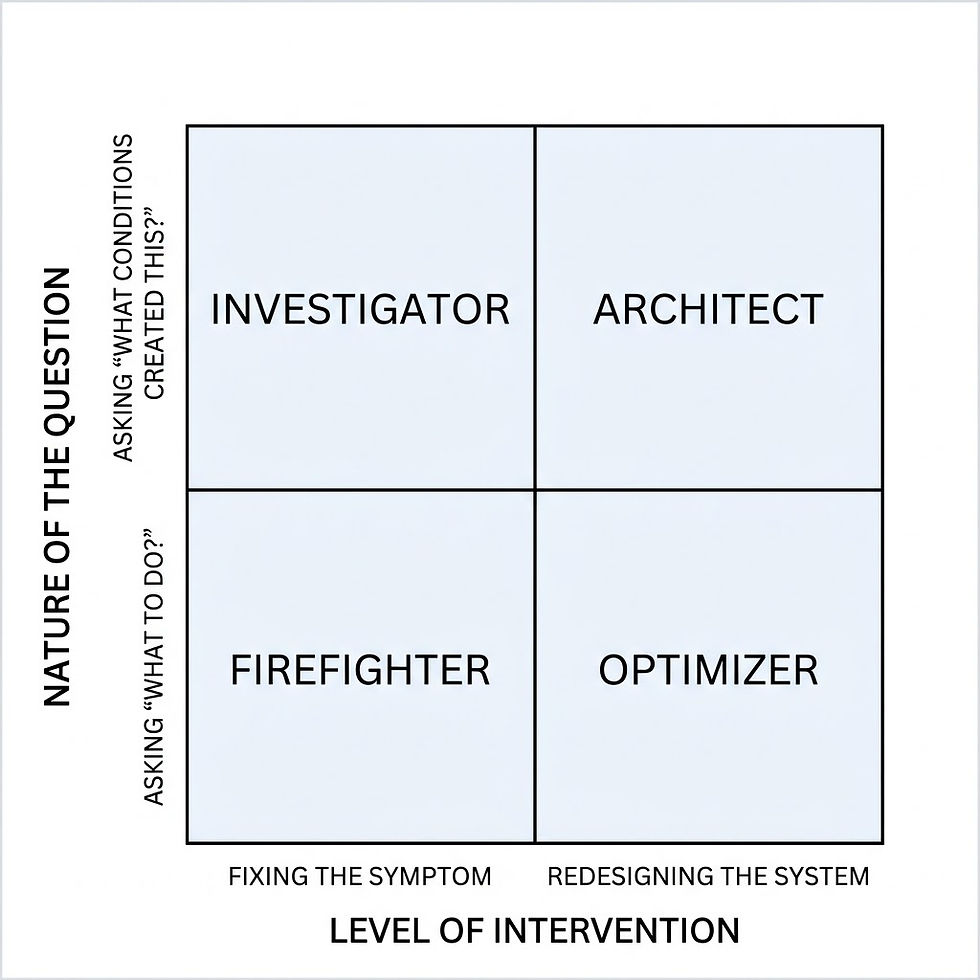
The matrix maps two dimensions that define leaders' responses to recurring problems.
On one axis: the nature of the question. Are you asking what to do, or what conditions created this?
On the other axis: the level of intervention. Are you fixing the symptom, or redesigning the system?
That gives us four leadership modes:
The Firefighter asks about the event and fixes symptoms. Fast, decisive, and exhausting. The fires keep coming because the conditions that create them are never addressed. Most high-performing leaders spend more time here than they would like to admit.
The Investigator asks systems questions but still intervenes at the symptom level. They can see the pattern but haven't yet found the leverage point to change it. Often, the most frustrated leader in the room knows something deeper is wrong but can't quite get to it.
The Optimizer fixes at the root-cause level, but with event-level questions. They are solving the right problem with the wrong diagnosis. Efficient, but optimizing a system that may need to be redesigned rather than improved.
The Architect asks what conditions created this outcome and intervenes at the system level. They don't just put out the fire. They ask why the building keeps catching fire and redesign accordingly. This is the leader who increases their organization's capacity rather than just maintaining it.
The goal is not to never be a Firefighter. Sometimes the building is actually on fire, and you need to move fast. The goal is to spend enough time as an Architect that you are building fewer buildings that catch fire in the first place.
Here is what this looks like in practice.
SaaS churn is a constant battle. Watch how each leader responds.
The Firefighter adds headcount, builds new QBR templates and escalation playbooks, and personally gets involved with at-risk accounts, hoping churn stabilizes and the team can just make it through the next quarter.
The Investigator pulls the data, sees the pattern, the churning customers all came from the same acquisition channels, but escalates it as a retention problem and funds another CSM training programme.
The Optimizer restructures incentives, penalizing sales for deals that don't renew and rewarding CSMs for saves. Revenue stabilizes slightly. The wrong customers keep coming through the door.
The Architect asks the condition question: What is it about how we sell that makes churn predictable? The answer is the Ideal Customer Profile. Do we know which customers actually get value from our product, and are we disciplined enough to only sell to them? Fix the ICP. Fix the churn. Permanently.
Same problem. Four different questions. One lasting solution.
The Three Levels of Curiosity
The transition from Firefighter to Architect is not a change in personality. It is a curiosity upgrade.
In that ninety-minute conversation I described, I was not doing anything sophisticated. I was just refusing to let my client stop at the first answer. Because the first answer is almost always an event. The real answer lives two or three levels deeper.
Level 1 — Event curiosity: What happened and who is responsible? This is where most leadership conversations begin and end. It produces fast answers and recurring problems.
Level 2 — Pattern curiosity: Why does this keep happening, and what are we consistently producing? This is where the Investigator lives. It requires slowing down long enough to see that this week's crisis and last quarter's crisis are the same crisis wearing different clothes.
Level 3 — Condition curiosity: What conditions exist that make this outcome inevitable? This is the Architect's question. It implicates the system, the design, and often the leader themselves. It is uncomfortable. It is also the only level of curiosity that produces lasting solutions.
The executive I described was stuck at Level 1. Every answer they gave me was an event, a person who underperformed, a missed deadline, a decision that went wrong. It took ninety minutes of "what caused that?" to get to the conditions underneath. Once we found them, three months of recurring problems suddenly had a single upstream cause.
We didn't solve the problems. We eliminated the conditions that were producing them.
Leadership Takeaways
The question determines the solution: If you only ask Level 1 questions, you can only find Level 1 answers. Level 1 answers to Level 3 problems create the recurring crises that exhaust leaders and frustrate teams.
Effort is not the answer: At a certain level of leadership, working harder inside a broken system makes you more indispensable and your organization more fragile. The Architect's job is to make themselves less necessary, not more.
The Firefighter is not the villain: Fast reactive problem-solving is a genuine leadership skill. The trap is when it becomes the only mode. The goal is to spend enough time as an Architect that you need the Firefighter less.
Conditions before accountability: Before you ask why a person failed, ask what conditions existed that made their failure likely. The answer will almost always point upstream.
If you are ready to make the transition from Firefighter to Architect and build systems that increase the capacity of your organization, this is the work I do with senior leaders. You can learn more here.
The Practical Step: Find Your Upstream Condition
Think about a problem your team has solved more than once in the last three months. Not a new problem. A recurring one. The same fire, different quarter.
Ask yourself three questions in order, and don't move to the next until you have genuinely answered the one before:
How are these recurring problems connected to each other?
What is causing them?
What conditions exist in how we are organized, incentivized, or designed that make these outcomes predictable?
That third question is the Architect's question. The answer is your leverage point.


Comments